The Healing Power of Prayer
In his book Seeing the Supernatural, Lee Strobel cited a study by Randolph Byrd that investigated the medicinal benefit of intercessory prayer to the Judeo-Christian God. This was a prospective, randomized, double-blind trial—the gold standard in experimental design—that studied 393 patients in a coronary care unit. The study is available on PubMed.1
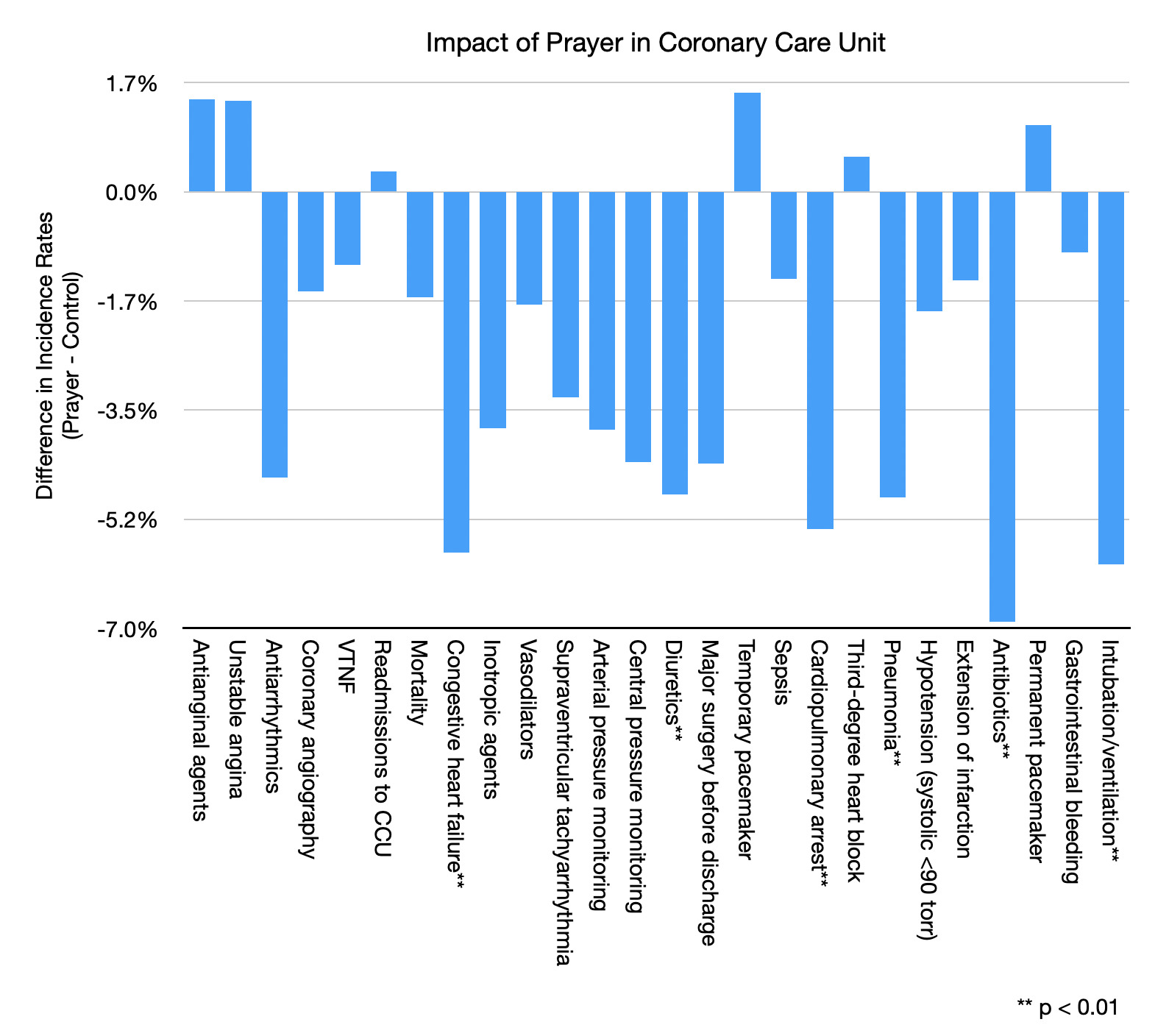
Prayer was associated with statistically significant (p < 0.01) reductions in the development of congestive heart failure, pneumonia, and cardiopulmonary arrest as well as in the use of diuretics, antibiotics, and intubation. A multivariate analysis of the data revealed near certainty (p < 0. 0001) that the observed differences are real—there is less than one-in-10,000 chance of such data emerging from groups with no actual difference. The changes in the incidence of all monitored events are shown in the chart below.
Given that prayer costs nothing and carries no risk of harmful side effects, why don’t doctors routinely prescribe it?